




What is - Medullary Thyroid Cancer
Medullary Thyroid Cancer (MTC) is a type of thyroid cancer. It is uncommon, making up about 5% of all thyroid cancers. Unlike the more common types of thyroid cancer (papillary and follicular thyroid cancer), MTC often needs care from a team of specialists.
How does Medullary Thyroid Cancer (MTC) develop?
MTC develops from the parafollicular cells, or C-cells, of the thyroid gland. These cells are different from the cells involved in other types of thyroid cancer. C-cells make substances called calcitonin and carcinoembryonic antigen (CEA). In MTC, the levels of calcitonin (and often CEA) in the blood can be higher than usual. Calcitonin is the most specific blood test for MTC and is a key test used to help diagnose it. Your healthcare team may also use calcitonin and CEA levels to help plan treatment and for monitoring after treatment.
What are the types of Medullary Thyroid Cancer (MTC)?
MTC is classified into two primary types:
- Sporadic MTC, which accounts for 75–80% of all MTC cases, occurs by chance in individuals with no family history of the disease.
- Hereditary MTC, which accounts for 20–25% of all MTC cases, is caused by an inherited mutation in the RET gene that is passed down through families. It may occur as part of Multiple Endocrine Neoplasia Type 2 (MEN2) or Familial Medullary Thyroid Cancer (FMTC).
Symptoms of Medullary Thyroid Cancer
Common symptoms include:
- A painless, firm lump in the thyroid.
- A swelling you can feel in your neck, or as enlarged lymph nodes seen on an ultrasound scan. These lymph nodes are usually found in the middle of the neck or along the sides.
- Long-lasting watery diarrhoea and facial flushing, which are symptoms caused by hormones made by the tumour, especially when calcitonin levels are high.
- Shortness of breath, difficulty swallowing, or voice changes (including hoarseness) if the tumour grows larger.
Make an appointment with your doctor if you have any signs or symptoms that worry you.
Medullary Thyroid Cancer - How to prevent
For most people, there is no proven way to prevent MTC. This is because most cases (75–80%) occur by chance and are not caused by anything you did or did not do. Prevention may be possible for people with hereditary MTC, where changes in the thyroid often follow a predictable pattern. First, the C-cells start growing abnormally. Very small tumours soon develop and over time these may grow into larger tumours (1 cm or larger). Because of this, family members who carry the gene mutation would benefit from prophylactic (preventive) thyroid surgery. This means removing the thyroid gland before cancer has a chance to form.
Medullary Thyroid Cancer - Causes and Risk Factors
The main cause of MTC is a genetic mutation in the RET gene. This mutation may either be inherited from a parent or acquired by chance during a person’s lifetime.
Genes contain the instructions that our body reads to carry out different functions. When working properly, the RET gene provides instructions for producing a protein involved in signalling within cells. This signalling is needed to control normal cell growth and nerve cell development.
A mutation in the RET gene can result in overproduction of this protein, which then signals cells to grow and divide uncontrollably, leading to tumour formation and cancer.
The location of the mutation within the RET gene can influence the age at which MTC develops, the likelihood of developing it, and how aggressive it may be. Management will depend on the location of the mutation within the RET gene.
What are some complications that arise from Medullary Thyroid Cancer (MTC)?
People with MTC can sometimes also develop problems in other hormone-producing glands. Two conditions that may be linked are hyperparathyroidism and pheochromocytoma.
- Hyperparathyroidism occurs when the parathyroid glands (small glands behind the thyroid) become overactive. These glands make parathyroid hormone, which helps control the calcium level in your body.
- Pheochromocytoma is a tumour that can develop in the adrenal glands (glands that sit on top of the kidneys). It can produce high levels of “stress hormones.” If a pheochromocytoma is not diagnosed before surgery, it can increase the risk of complications during general anaesthesia. To screen for this, your doctor may order a blood test (serum metanephrines) or a 24-hour urine test (urine metanephrines). Higher-than-normal results may suggest a pheochromocytoma and would require further tests.
Diagnosis of Medullary Thyroid Cancer
How is Medullary Thyroid Cancer (MTC) diagnosed?
Tests and procedures used to diagnose MTC include:
History and Physical Examination
Your doctor will ask about your symptoms and whether anyone in your family has had thyroid, parathyroid, or adrenal conditions. They will also examine your neck to check the thyroid gland and to feel for any swollen lymph nodes.
Thyroid Ultrasound and Fine Needle Aspiration Cytology (FNAC)
An ultrasound scan of the thyroid is used to check for thyroid nodules or lumps. Depending on the size and appearance of the nodule, your doctor may recommend a fine needle aspiration (FNA) biopsy. This involves using a very thin needle to take a small sample of cells from the nodule. The sample is then examined under a microscope to check for MTC.
During the same ultrasound, the doctor will also check the lymph nodes in the central and side areas of your neck to see if any look abnormal. If needed, a biopsy of a lymph node can be done as well.
Biochemical Assessment
- Calcitonin
- Carcinoembryonic Antigen (CEA)
- Thyroid Function
- Parathyroid Hormone
- Calcium
- Plasma Metanephrines or Urine Metanephrines
If MTC is suspected, you will need additional blood tests. Your healthcare team will check your calcitonin and CEA levels. The calcitonin level can give useful information about how extensive the disease may be and can help guide surgery planning. Thyroid function tests measure your thyroid hormone levels and thyroid-stimulating hormone (TSH) to see whether your thyroid is working normally.
Nasoendoscopy
A nasoendoscopy is usually performed before surgery to check how your vocal cords are moving. This is more likely if you have an abnormal voice, have had previous neck surgery, or if the MTC appears locally advanced, as there is a higher likelihood of recurrent laryngeal nerve involvement, which could affect your vocal cords.
Knowing how the diagnosis was made helps your healthcare team plan the best next steps and follow-up for you.
What is Multiple Endocrine Neoplasia Type 2?
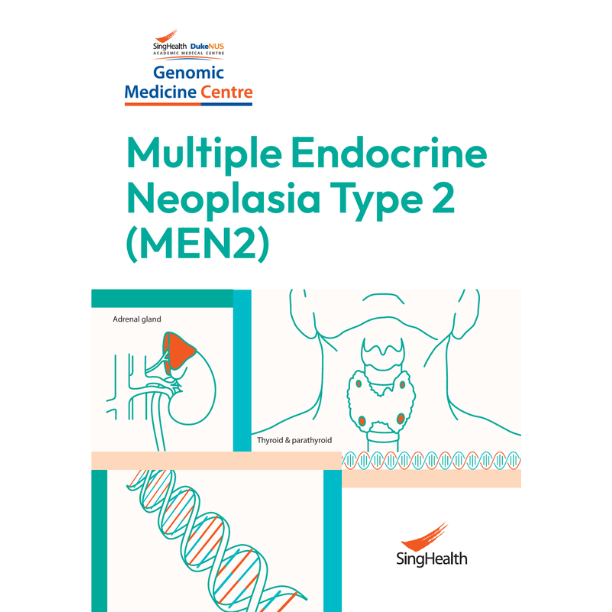
Multiple Endocrine Neoplasia Type 2 (MEN2) is a hereditary condition associated with an increased risk of developing tumours and cancers in the endocrine (hormone-producing) glands, including the thyroid, parathyroid glands, and adrenal glands.

How is MEN2 inherited?
MEN2 follows an autosomal dominant inheritance pattern. This means that having one altered copy of the RET gene can increase the risk of cancer. Having an inherited faulty gene does not mean that you will develop cancer, but it does increase your risk.

- A parent with a faulty gene has a 50% chance of passing down the faulty gene to their children (both sons and daughters).
- A child, sibling or parent of a family member with the faulty gene has a 50% chance of also inheriting the same faulty gene.
- Extended relatives may also inherit the faulty gene.
What are the tumour and cancer risks associated with MEN2?
| Medullary Thyroid Cancer risk in individuals with a faulty RET gene | ||
| MEN2A | 4-8% by age 10 25-50% by age 28 |
80% by age 50 Almost 100% by age 70 |
| MEN2B | 100% by age 10 | |
Depending on your genetic result and personal or family history of cancer, your individual risk may differ from the values shown above. A classification system is used to determine the MTC risk level based on the location of the mutation in the RET gene.
It is best to speak with your genetics service to understand your risk level. Your healthcare team will also advise you on the medical care that may or may not be beneficial, based on your risk level.
Who should undergo genetic testing for MEN2?
Some people are diagnosed through genetic testing, often before symptoms start, which can be helpful since treatment can begin earlier. You should consider genetic testing if you or your family members meet one or more of the following criteria:
- Medullary thyroid cancer
- Paraganglioma or phaeochromocytoma (types of tumours that arise from specialised nerve cells or the adrenal glands)
- Family members who have previously been identified to have MEN2 syndrome.
Medullary Thyroid Cancer (MTC) – Staging
MTC is staged using the American Joint Committee on Cancer (AJCC) TNM system.
An ultrasound of the neck is performed to assess the tumour in the thyroid and detect enlarged or abnormal lymph nodes in the neck. Your doctor may arrange additional scans if there is a possibility that the cancer has spread to other organs, such as the lungs, liver, or bones. This is more likely if your calcitonin level is above 500 pg/mL. These scans help determine the location of the cancer and how far it has spread.
Scans (Structural Imaging)
- Computed Tomography (CT scan) of the neck, chest, and abdomen
- Magnetic Resonance Imaging of the Liver (MRI Liver)
- Bone Scan
For some patients whose cancer has returned or spread to other parts of the body, specialised scans may be used to guide treatment decisions. These scans can sometimes detect cancer that does not show up on regular CT or MRI scans. Your doctor will discuss which type of scan is most appropriate for your specific situation.
Treatment for Medullary Thyroid Cancer
Treatment for MTC depends on several factors, including the stage of the cancer and any other health conditions the patient may have. Your doctor will check whether you have any other related tumours before deciding on the most appropriate treatment. This is important because some people with MTC may also develop tumours in other hormone-producing glands. One example is phaeochromocytoma, a tumour that can develop in the adrenal glands (glands that sit on top of the kidneys).
Your doctor will usually order blood tests to help guide your treatment. Your calcitonin blood level can provide clues about how far the cancer may have spread. Calcitonin levels between 20 and 50 pg/mL are associated with spread to nearby lymph nodes.
Levels above 500 pg/mL suggest that the cancer may have spread to other parts of the body, such as the lungs, liver, or bones.
Surgery for Medullary Thyroid Cancer
MTC is usually treated with surgical removal of the thyroid.
- Thyroidectomy usually involves removing the entire thyroid gland.
- Surgery may also involve removing lymph nodes in the neck. This can include lymph nodes close to the thyroid (the central neck area) and lymph nodes along the sides of the neck (the lateral neck areas). Lymph nodes are removed because cancer cells can sometimes spread there. Your doctor will decide which lymph nodes need to be removed based on your test results, the size and location of the tumour, and whether there are signs that the cancer has spread.
Radiation Therapy for Medullary Thyroid Cancer
External beam radiation therapy (EBRT) is a type of radiation treatment that uses high-energy X-rays to kill cancer cells. It is not used routinely for MTC, but it may be recommended in certain situations. For example, it may be used if there is a high risk that the cancer may come back, if the cancer could not be completely removed during the first surgery, or if the cancer has spread to the bones and is causing pain.
Targeted Therapy
Targeted therapy uses drugs that focus on specific features of cancer cells. Before starting them, your doctors will test the cancer to see whether it has changes in the RET gene. This helps them choose the most suitable medicine for you.
Targeted therapy can help slow the cancer’s growth and spread. The drugs used can also help reduce symptoms caused by high calcitonin levels, such as diarrhoea and flushing, which may improve day-to-day quality of life.
FAQs on Medullary Thyroid Cancer
- How does genetic testing help in detecting MTC?
Approximately 20–25% of MTC cases are inherited and associated with a hereditary condition. Genetic testing can confirm the diagnosis and help guide surveillance and medical management based on the risks associated with the condition.
- Is surgery the main treatment?
Removing the thyroid and any affected lymph nodes offers the best chance of cure. Before surgery, you may also need screening for related conditions like pheochromocytoma. If MTC comes back or has spread, treatments such as radiation therapy and/or targeted therapies may help control symptoms and slow progression, even though they are not usually curative.
- I was diagnosed with medullary thyroid cancer after a partial thyroid removal. What should I do next?
Sometimes, MTC is diagnosed only after surgery to remove half of the thyroid. This may occur when the initial results from testing the thyroid nodule are inconclusive. If this happens, further tests are needed so that your doctors can fully assess the situation and plan the next steps. You will need blood tests for calcitonin and CEA, which are important markers for MTC. Genetic testing is also recommended to check for inherited pathogenic or likely pathogenic variants that may indicate how aggressive the MTC is likely to be. Based on these results, your doctors will advise whether you need a second operation to remove the remaining half of the thyroid, known as a completion thyroidectomy.
- What are some examples of targeted therapy used for MTC?
There are two main types of targeted medicines for MTC. If the cancer does not have RET gene changes, doctors may use medicines called multi-kinase inhibitors, such as vandetanib and cabozantinib. If the cancer does have RET gene changes, there are newer medicines called RET inhibitors, including selpercatinib and pralsetinib. The newer RET inhibitors often have fewer side effects, but it is still important to tell your medical team about any symptoms so they can help manage side effects.
- Do I need regular follow-up after treatment?
It is important to go for regular follow-up after treatment. Blood tests for calcitonin and CEA can pick up signs of recurrence early, sometimes even before you feel any symptoms.
- Is there any medication that I should avoid if I am diagnosed with MTC or MEN2 syndrome?
There are some medications that you should avoid if you have been diagnosed with MTC or MEN2, or if you have a family history of MTC. These include semaglutide (Ozempic, Wegovy, and Rybelsus), tirzepatide (Mounjaro), liraglutide (Victoza and Saxenda), and dulaglutide (Trulicity).
Post-Surgery Care for Medullary Thyroid Cancer
What to expect after surgery for Medullary Thyroid Cancer
Many patients begin recovering soon after surgery. Most patients stay in hospital for one to two days after a standard thyroidectomy and two to five days if lymph nodes are also removed.
It is common to have some neck and throat discomfort, which can usually be managed with pain medicine. These symptoms usually improve gradually over the first few weeks. Speak to your healthcare team if you are worried about your post-operative symptoms.
Following a total thyroidectomy, patients typically require lifelong thyroid hormone replacement because the body can no longer produce thyroid hormones naturally. Most people can return to light activities within about a week. Over the longer term, your healthcare team will monitor you closely through regular blood tests to check your recovery and look for any signs that the cancer has recurred. Your doctor will measure calcitonin and CEA levels, usually starting about two to three months after surgery. An undetectable calcitonin level suggests that the cancer has been fully removed. Your doctor may recommend additional scans if calcitonin remains detectable. It is important to follow your doctor’s advice and complete the recommended scans and tests so that timely treatment can be provided if the cancer recurs or other problems arise.
Understanding what to expect can make the recovery process less overwhelming and help patients feel more confident about their progress.
What is the prognosis for someone with Medullary Thyroid Cancer?
Early detection and treatment of MTC usually offer the best outlook. However, in some cases, MTC may already have spread by the time it is diagnosed. Overall survival and outlook depend on several factors, including:
- The stage of the cancer
- For early-stage MTC (stages I–III), approximately 92% of patients survive for 10 years after diagnosis.
- For stage IVA–IVB MTC, approximately 77% of patients survive for 10 years after diagnosis.
- For cancer that has spread to distant parts of the body (stage IVC), approximately 38% of patients survive for 10 years after diagnosis.
- If the cancer has spread to other parts of the body When MTC is detected as a lump that can be felt, it has often spread to nearby neck lymph nodes and to distant areas like the lungs, liver or bones.
- Doubling time of calcitonin level This refers to how long it takes for the calcitonin level to double. If the doubling time is short—that is, if the level rises quickly—the tumour is usually more aggressive. A longer doubling time generally indicates a better outlook. As each patient’s situation is different, it is important to speak with your healthcare team for a clearer understanding of your condition.
At NCCS, patients are supported throughout each stage of their cancer journey with personalised care, regular monitoring and long-term follow-up that goes beyond the recovery stage. Speak to your healthcare team if you have questions about navigating through your cancer treatment and recovery after surgery for MTC.
Medullary Thyroid Cancer - Other Information
Contributed by
The information provided is not intended as medical advice. Terms of use. Information provided by SingHealth.
Our Medical Specialists
1
2
3
4
5
1
2
3
4
5
Our Medical Specialists
1
2
3
4
5
Health Articles
Stay Healthy The Easy Way

Get trusted health advice, offers and more.
Stay Ahead in Healthcare Industry

Subscribe to our exclusive updates for healthcare professionals.
















Keep Healthy With
 HealthXchange
 Health Videos
Follow NCCS


© 2026 National Cancer Centre of Singapore Pte Ltd. All Rights Reserved.